An unprecedented surge in software vulnerabilities have raised concerns about online security. Here’s what you can do to protect yourself.

Millions of attempted cyberattacks, major healthcare data breaches, and an unprecedented surge in software vulnerabilities have raised concerns about online security. Experts warn that artificial intelligence could make the situation worse. Here’s what you can do to protect yourself.
A wave of cybersecurity incidents is raising concerns about the safety of personal information online, as artificial intelligence accelerates the discovery of vulnerabilities across some of the internet’s most widely used software.
Over the past several days, critical vulnerabilities in PHP, a programming language used by millions of websites, have triggered emergency security responses around the world. Cloudflare has reported millions of attempted attacks following the disclosure, while governments and businesses have rushed to secure their systems.
Meanwhile, medical testing giant Quest Diagnostics has confirmed a separate cyberattack involving sensitive patient information.
The developments come as security experts warn that AI could significantly accelerate the pace at which software vulnerabilities are discovered and exploited.
Cloudflare reports millions of attempted attacks after PHP vulnerabilities exposed
On October 21, security researchers disclosed two major vulnerabilities in PHP, collectively known as php2shell.
The vulnerabilities, identified as CVE-2026-109618 and CVE-2026-109619, could potentially allow attackers to execute malicious code, disrupt websites, or expose sensitive information under certain conditions.
According to Reuters, Cloudflare CEO Matthew Prince reported that attempted exploitation surged dramatically following the disclosure.
The company detected thousands of attempts before the vulnerabilities were publicly announced. Within 45 minutes, that number had increased to tens of thousands.
Within two hours, Cloudflare had recorded hundreds of thousands of attempts, with the total eventually reaching millions.
Those figures represent attempted attacks, not millions of confirmed successful hacks.
The situation prompted emergency responses internationally, including temporary service disruptions as organizations worked to install security updates and assess their exposure.
Cloudflare confirmed that it had deployed web application firewall protections ahead of the public disclosure to help shield vulnerable websites.
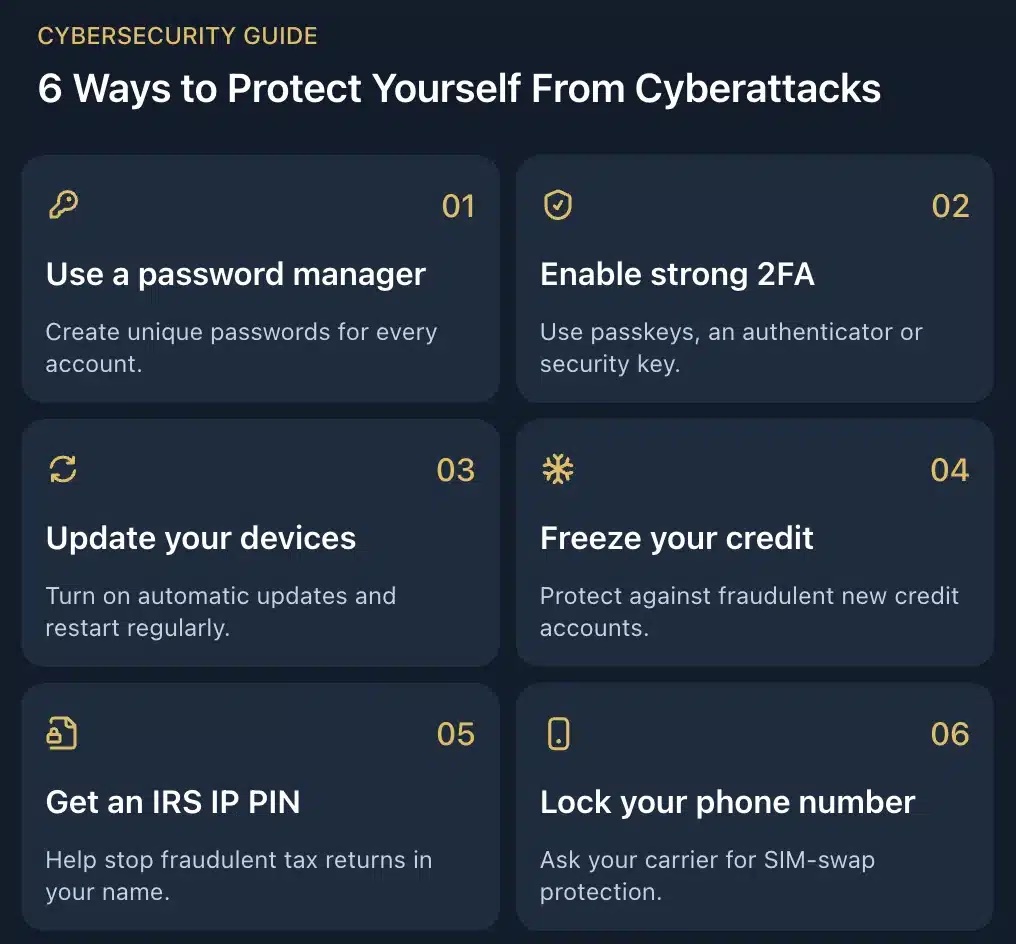
Six practical cybersecurity precautions that can help protect personal accounts, finances, and sensitive information.
Quest Diagnostics confirms patient information was compromised
The recent cybersecurity concerns extend beyond website vulnerabilities.
Medical testing giant Quest Diagnostics confirmed that hackers gained unauthorized access to its Quanum laboratory system, which healthcare providers use to order tests and access patient information.
According to TechCrunch, Quest disclosed the incident after discovering unauthorized access on October 21.
The company confirmed that personal information and certain patient records were compromised, although the full scope of the breach remains under investigation.
It has not yet established how many patients were affected or precisely what information was taken.
Quest said the incident was unrelated to the newly disclosed PHP vulnerabilities.
The company has experienced major security incidents before, including a 2019 breach involving a third-party billing provider that affected approximately 11.9 million patients.
The latest incident illustrates a difficult reality: Even people who take precautions with their own devices can have sensitive information exposed when organizations storing their data are compromised.
Other major cybersecurity incidents have affected healthcare and technology companies
Quest is not the only organization facing significant cybersecurity problems.
Earlier this month, Microsoft released security updates addressing 1,411 vulnerabilities, highlighting the enormous volume of software weaknesses that companies are being forced to address.
Healthcare organizations have also faced repeated attacks throughout 2026.
In August, medical device manufacturer Boston Scientific reported a cyberattack that caused major operational disruption.
Separately, CareCloud began notifying patients after hackers stole medical records in another healthcare data breach.
These incidents were not necessarily connected, and there is no established evidence that all were caused by AI.
However, they demonstrate how security vulnerabilities and cyberattacks can affect services that millions of people depend on.
Software vulnerability reports are surging in 2026
The growing cybersecurity concerns come amid a dramatic increase in publicly reported software vulnerabilities.
According to CVE Trends, September 2026 recorded approximately 15,180 published Common Vulnerabilities and Exposures, or CVEs, compared with 5,244 in January.
That represents nearly three times as many reported vulnerabilities in September as in January.
A CVE is a standardized identifier for a publicly disclosed security vulnerability. These vulnerabilities range from relatively minor software weaknesses to critical flaws that could allow attackers to compromise entire systems.
Not every CVE is classified as critical, and not every disclosed vulnerability has been exploited.
The increase has also been documented by major technology companies.
In a June 2026 report, GitHub revealed that private vulnerability reports across its platform increased from approximately 550 per week in January to more than 3,000 per week during much of May.
Repository security advisories increased from approximately 650 per week to more than 5,000, while requests for new CVE identifiers reached nearly 4,000 in May alone.
GitHub published a record 1,560 reviewed security advisories that month, more than five times its typical monthly output.
The surge does not necessarily mean cybercriminals are successfully hacking more systems. But it does demonstrate the growing volume of security weaknesses that developers and cybersecurity teams must investigate and address.
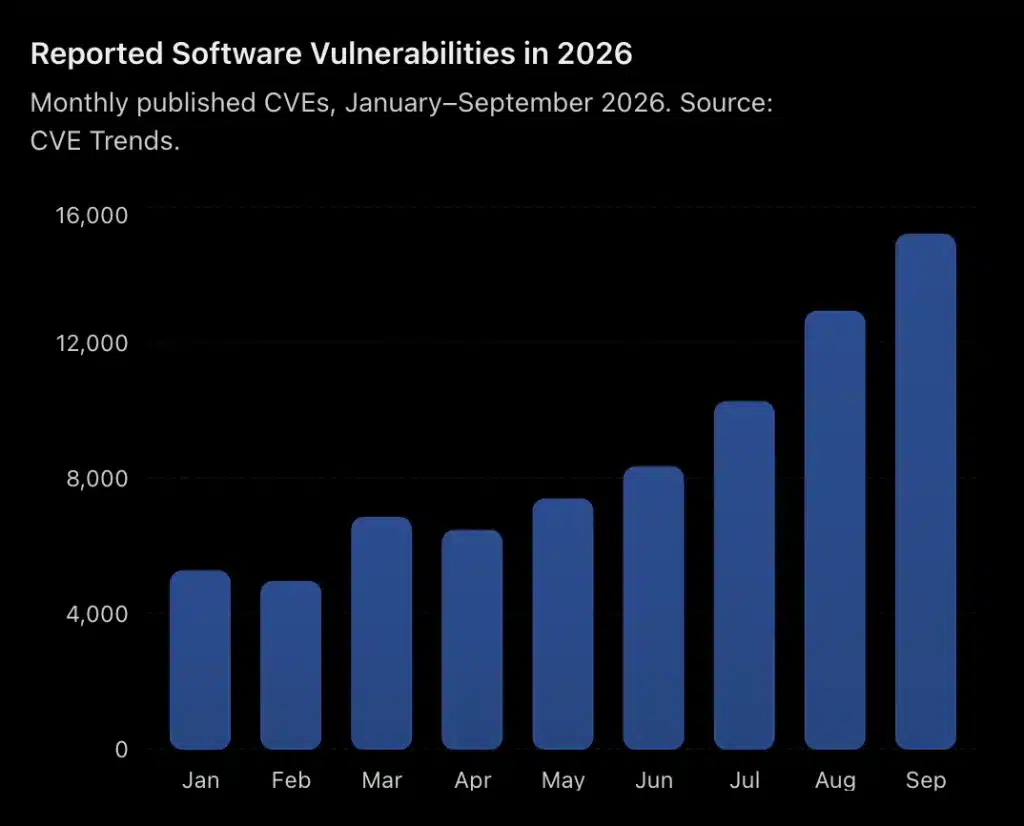
Monthly CVE disclosures increased sharply throughout 2026, reaching a record 15,180 in September, according to CVE Trends. The figures represent reported vulnerabilities, not successful cyberattacks.
How artificial intelligence is changing cybersecurity
One of the most significant concerns surrounding the latest cybersecurity incidents is the growing role of artificial intelligence.
The recent PHP vulnerabilities were discovered with the assistance of AI-powered tools, demonstrating how artificial intelligence can identify software weaknesses that may have remained undetected for years.
This can benefit legitimate security researchers, who can use AI to discover vulnerabilities and help developers repair them.
However, similar capabilities may also benefit cybercriminals.
AI systems can assist with analyzing software, identifying potential vulnerabilities, and automating portions of the exploitation process.
As these tools improve, attackers may be able to discover and exploit vulnerabilities faster than organizations can install security patches.
In an October 23 Reuters report, cybersecurity experts warned that AI-assisted vulnerability discovery could lead to more frequent disruptions across the internet.
The report also highlighted vulnerabilities and security incidents involving other widely used software and technology services.
Still, the distinction matters: AI is contributing to the acceleration of vulnerability discovery, but that does not establish that every recent cyberattack was conducted using AI.
Anthropic security leader warns things could get worse
Jason D. Clinton, Anthropic’s deputy chief information security officer, issued a stark warning on October 22 about the rapidly evolving cybersecurity environment.
In a post on X, Clinton warned that the situation could become significantly worse before improving.
He urged security leaders to seek additional support from their organizations and prioritize fundamental security protections rather than focusing exclusively on AI.
Clinton also referenced an earlier warning he made in August about an approaching surge in software vulnerabilities, arguing that organizations needed to prepare before the situation escalated.
He suggested that defenders may need to endure approximately 18 months of heightened cybersecurity risk.
That timeline is Clinton’s assessment, rather than an established prediction of how long the current problems will persist.
His warning reflects a growing concern among security professionals that AI-assisted vulnerability discovery could overwhelm organizations already struggling to maintain and secure their systems.
Six ways to protect yourself from cyberattacks
Although individuals cannot prevent every corporate data breach or software vulnerability, several straightforward precautions can significantly reduce the risk of identity theft, account takeovers, and financial fraud.
- Use a password manager and never reuse passwords
Using the same password across multiple websites allows criminals to potentially access several accounts after obtaining credentials from a single compromised service.
Password managers such as 1Password, Bitwarden, and Apple’s Passwords app can generate and securely store unique passwords.
Start by securing your email, banking, financial, and social media accounts.
- Enable two-factor authentication
Two-factor authentication provides an additional layer of protection beyond your password.
For important accounts, prioritize passkeys, physical security keys such as YubiKey, or authenticator applications such as Google Authenticator.
These methods generally offer stronger protection than SMS verification, which can be vulnerable to phone-number hijacking and SIM-swapping.
However, SMS-based verification is still better than having no second factor.
- Enable automatic updates and restart your devices
Software updates frequently contain important security patches addressing vulnerabilities that attackers may already know about.
Enable automatic updates for your phone, computer, operating system, browser, and applications.
Restart your devices regularly to ensure updates requiring a reboot are installed.
Website owners should also update their hosting software, plugins, and content-management systems.
Organizations running PHP-based websites should review the latest Cloudflare guidance and applicable security patches.
- Freeze your credit
A credit freeze can help prevent criminals from opening new credit accounts using your identity.
In the United States, you can freeze your credit for free through all three major credit bureaus:
• Equifax
• Experian
• TransUnion
You can temporarily lift the freeze when applying for a loan, credit card, or other service requiring a credit check.
A credit freeze does not prevent every form of identity theft, but it can reduce the risk of new-account fraud.
- Get an IRS Identity Protection PIN
The Internal Revenue Service offers a free Identity Protection PIN that helps prevent someone else from filing a fraudulent federal tax return using your identity.
You can request one directly through the official IRS website.
The six-digit PIN changes annually and should be kept private.
- Lock your phone number against SIM-swapping
Criminals can sometimes take control of a phone number by convincing a mobile carrier to transfer it to another SIM card or provider.
This can allow them to intercept account-recovery messages and authentication codes.
Contact your mobile carrier and ask about a port-out PIN, number lock, or additional account-security restrictions.
These measures can make unauthorized transfers more difficult, although their effectiveness depends on the carrier.
Additional steps to protect your finances and personal information
• Cybersecurity experts also recommend monitoring financial accounts for suspicious activity and enabling transaction alerts.
• Maintaining accounts at more than one insured financial institution may help preserve access to funds if a bank experiences a prolonged service disruption.
• Consumers should also remain alert for phishing messages impersonating companies involved in recent breaches.
• Criminals frequently exploit public concern following cybersecurity incidents by sending fraudulent emails or text messages claiming that an account has been compromised.
• Avoid clicking unexpected verification links. Instead, visit the company’s official website or app directly.
For additional guidance, the Federal Trade Commission’s IdentityTheft.gov website provides resources for responding to identity theft and protecting personal information.